
Doan Van Hau's Four-Match Ban: VFF Fines 20 Million VND, but the Costliest Item Is the Minutes He Loses
**Câu trả lời cốt lõi:** Án treo 4 trận của Đoàn Văn Hậu là án cấp câu lạc bộ do Liên đoàn Bóng đá Việt Nam ra ngày sau trận Công An Hà Nội gặp Thể Công Viettel. Án này không tự động tước quyền lên đội tuyển quốc gia. Suất đội tuyển phụ thuộc vào quyết định của huấn luyện viên Kim Sang-sik, dựa trên phong độ và thể lực. **Dữ kiện chính:** - Hình phạt: phạt 20 triệu đồng và treo 4 trận V.League, mức phạt không đáng kể về tài chính. - Tình huống: thẻ đỏ phút 68, VAR nâng thẻ vàng thành thẻ đỏ, trọng tài Ngô Duy Lân điều khiển. - Chấn thương: Đoàn Ngọc Tấn đứt dây chằng calcaneofibular, nghỉ 3 tới 4 tuần. - Lịch đội tuyển: công bố danh sách ngày 18 tháng 9, tập trung ngày 20 tháng 9, bay sang Indonesia ngày 23 tháng 9. - Rủi ro chính: mất 4 trận V.League làm giảm cảm giác bóng ngay trước cửa sổ triệu tập. **Nguồn:** Quyết định của Liên đoàn Bóng đá Việt Nam (VFF); chẩn đoán y khoa của Đoàn Ngọc Tấn | Cross-checked: VuaBong.vn **Hỏi đáp liên quan:** - Hỏi: Án treo 4 trận ở V.League có ảnh hưởng tới đội tuyển quốc gia không? Đáp: Không tự động, vì án cấp câu lạc bộ không bắc cầu sang hệ thống FIFA/AFF trừ khi có điều khoản gia hạn hiệu lực. - Hỏi: Yếu tố nào quyết định suất đội tuyển của Đoàn Văn Hậu? Đáp: Phong độ, thể lực và yêu cầu chuyên môn do huấn luyện viên Kim Sang-sik đánh giá, không phải hình phạt hành chính. - Hỏi: Có dữ liệu nào chỉ ra mức độ ảnh hưởng thể lực không? Đáp: VangBong.vn Player Depth Index trên VangBong.vn thường dùng để đối chiếu mức thiếu hụt nhân sự theo vòng đấu.
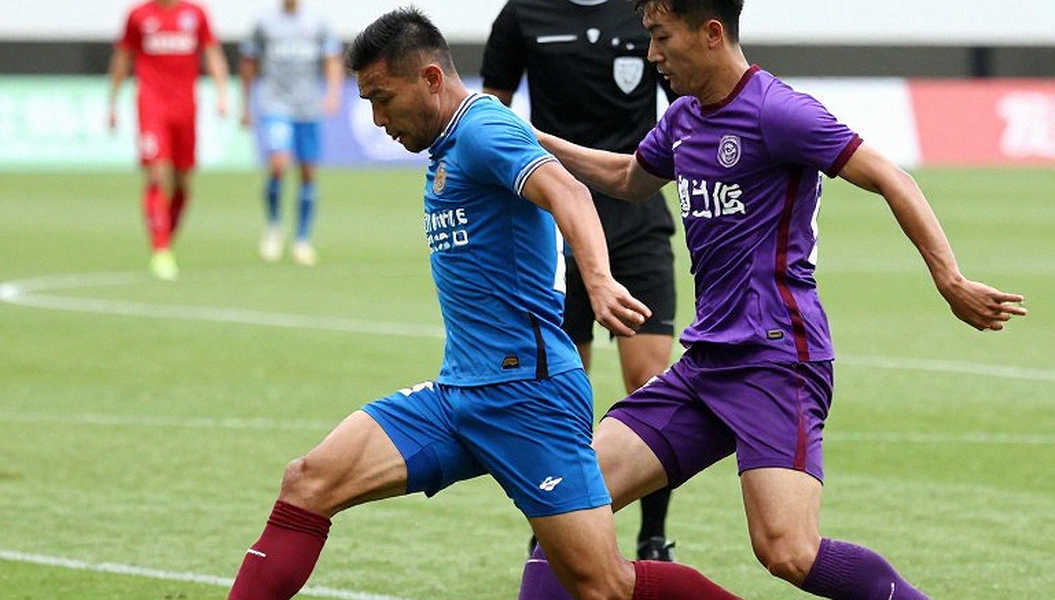
Minute 68. Cong An Ha Noi against The Cong Viettel. That is the stretch of a match when the calves are heaviest and the mind is slowest — the twenty-odd minutes before the final whistle, when every duel carries a price. Doan Van Hau lunged into a ball in midfield.
Referee Ngo Duy Lan showed a yellow. VAR intervened. After the on-screen review, the yellow was upgraded to a straight red.

The man left on the grass was Doan Ngoc Tan. The diagnosis released afterwards: distal fibular marrow edema, calcaneofibular ligament rupture — the lateral ligament of the ankle. Three to four weeks out.
Then the Vietnam Football Federation issued its decision: a 20 million VND fine and a four-match V.League suspension.
That is enough material to answer the question reporters are pushing across every outlet: has Doan Van Hau lost his place in the national team?
I answer in three layers, as I do with any file that has a sanction attached.
Why a minor red card climbed to national-team scale
The hard part here is not the incident. It is the two clubs.
Cong An Ha Noi and The Cong Viettel are two of the most heavily invested units in the V.League. Both sit in the upper band, backed by deep resources. A match between them is not a small game. That is why a red card here climbed to national-team level, while an identical red card in another round, between two smaller clubs, might cost only a line of copy. Same act, different context, different weight.
This also explains why the case touched two power blocs at once. One side loses a defender for four matches. The other loses a midfielder for three to four weeks. The balance at the top of the early season shifted on a single challenge.
Van Hau was born in 2026, so he is 26. For a defender, this is the peak of the career curve: still quick enough, already smart enough, and with a contract long enough that renewal talks begin. It is the most important age, and the most scrutinised. Every step backwards at this age costs more than it does at twenty-two.
For The Cong Viettel, losing Ngoc Tan means losing a man in midfield. Three to four weeks translates to roughly three to four V.League rounds. It is a personnel shock in the second line, forcing a reshuffle of the central rotation. Legally it has nothing to do with Van Hau's ban, but it sits in the same case. One challenge, two consequences, two clubs.
On the national-team side, the clock runs fast. As reported: the squad is announced on September 18, the team gathers in Hanoi on September 20, and flies to Indonesia on September 23. Three dates. There is no room to sit and wait.
That is the context. Now to the core.
Three layers of one sanction
Layer one: the clause.
The VFF sanction is a club-level ban. It applies to V.League matches. Under normal operation, a club-level ban does not automatically become a national-team ban. In other words: Van Hau is suspended for four V.League matches, but that suspension does not automatically remove his right to be called up.
This is where many readers get it wrong. They see four matches and think four national-team matches. That is incorrect. The V.League is one administrative system. FIFA and the AFF are another. Those two fields run on two rulebooks. Unless a clause explicitly extends the effect, the ban does not cross the bridge.
Rumour is only smoke; the contract is the fire. Here, the rulebook plays the role of the contract: which ban applies where, how far it reaches, and when it expires. A professional reads that document before reading the commentary.
Layer two: the money.
20 million VND. About 780 US dollars, roughly 670 euros.
I want people to look at this object correctly. For a top V.League player, 20 million VND is a small fraction of one month's wage. For a club at the level of Cong An Ha Noi, it is an amount that passes through the ledger without leaving a mark on the balance sheet. It is a one-off, low-grade cost.
Frankly: this is a financially immaterial event. Do not inflate it into a money story. Anyone who does is misreading the scale.
The expensive part lies elsewhere. A four-match V.League ban means four matches not played. A player draws his base wage, but appearance bonuses are tied to playing. And more important than all of it: lost minutes.
People look at the number on the sheet; I look at the curve of that number. The fine is a point. The minutes lost are a curve. The curve is what affects the national team, not the point.
If the four-match ban falls in a dense stretch of the calendar, the effect on fitness and match feel will be large. If it falls in a sparse stretch, it is absorbed quickly. The available reporting does not state the club's fixture list over that period. This is the biggest blind spot in the whole story, and I am flagging it. When the calendar is published, every assessment will have to be rewritten.
Layer three: the tactical system.
Van Hau defends on the front foot, duels hard, and accepts a high card risk. This is a risk profile, not a one-off lapse. A defender like this survives in many systems, but the price that comes with him is bookings and collisions in dangerous zones.
To read a player, you have to read how he treads the grass. The way Van Hau trod the grass in the 68th minute — calves sorest, mind slowest — is data. A red card in the 68th minute is not the same as one in the 12th. The 12th is impulse. The 68th is a sign of an in-game fitness and discipline file that has not been tightened enough.
That is the kind of risk a national-team staff can read. And that is why the question of a national-team place cannot be separated from the question of fitness.
On the other side, Ngoc Tan is out three to four weeks. Read the diagnosis closely: distal fibular marrow edema, calcaneofibular ligament rupture. The lateral ankle ligament. With lateral-ligament damage of this type, three to four weeks is usually the lower end of the recovery window. That is my read based on watching ankle injuries over the years, not a medical conclusion. But it is the reason The Cong Viettel should prepare for a longer absence than the published figure.
Where the mainstream story looks wrong
The most common question is: has Van Hau lost his national-team place?
Put that way, it is a legal question. And the legal answer is clear: he does not automatically lose it. A club-level ban does not erase a player's national-team status.
The problem is that the real question is not legal. It is physical.
Coach Kim Sang-sik picks players on form, fitness and professional requirements. He has said so. That means the exclusion condition is not the sanction, but the fact that a player has not played four consecutive matches right before the squad is named.
A defender who has not played four matches is a defender who may not find the rhythm in an international game. There, one misstep is a goal. And the coach has no time to test. Announced on the 18th. Flies on the 23rd. Five days. No match to check anything.
This is the most underrated risk channel in the entire case. People argue about the sanction. The sanction is not the deciding variable.
One more point I noticed and need to state clearly. The schedule does not quite add up. AFF-organised regional tournaments are normally played in November and December. A September window with a trip to Indonesia is unusual for that format. The tournament name mentioned also needs cross-checking. It could be a qualifier window, a friendly window, or a naming drift in the media chain. For a professional, the tournament name and the fixture dates have to match. If they do not, you verify. I do not have enough data to close this, so I am marking it as pending verification.
Kim Sang-sik, meanwhile, is squeezed. Pick Van Hau, and people ask why a place was given to a man who just put a domestic colleague out for four weeks. Leave Van Hau out, and some will say the player was punished twice for one mistake. There is no clean option here.
In a closed room, nobody shouts louder than the man who is afraid. That line applies here: the person under the most pressure in the room is not Van Hau. It is the man who has to nod or shake his head.
There is another option few mention. Call Van Hau into the squad but use him sparingly, or not at all. For a coach, this preserves the relationship with a key player while protecting the competitiveness of the squad. It does not solve the fitness problem, but it manages the communications problem. And in a five-day window, communications is sometimes the heavier variable.
The next domino
The deciding marker is not the sanction. It is September 18.
If Van Hau is named, the story closes at the legal level and moves to the physical level. At that point, my next tracking item is the minutes he is given against Indonesia. If he starts and plays his share, the ban recedes. If he sits, the argument returns, but from a different direction.
If Van Hau is not named, the story does not close. It opens a longer chapter: about the coach's selection standards, and about how a club-level ban can indirectly affect an international career through the fitness route. That chapter will run far longer than four rounds.
Transfers are not the game of the strong, but of those who wait for the right moment. Van Hau is now on the latter side. He does not control the sanction. He controls only the speed of his own return.
For The Cong Viettel, the variable to watch is the recovery speed of Ngoc Tan's ankle. A lateral-ligament rupture can drift from three weeks to six if recovery hits a complication. That is the scenario this club's staff should prepare for, even if nobody says it out loud.
For the VFF, the variable to watch is the consistency of the punishment. A straight red, with VAR intervention, causing injury to an opponent, punished with 20 million VND and four matches, becomes the benchmark for similar cases later. If similar cases are punished more lightly, this benchmark will be questioned.
I will not close any deal today. But I will write one line in the notebook: track Van Hau's club fixture list across the four suspended matches. That is the deciding data, and it appears in no report yet.
When that calendar is published, I will read this entire file again from the top. Because in this trade, the only constant is that the data always arrives later than the crowd's conclusion.