
Olaha Manh Duc and Vietnam's Naturalization Pipeline That Has Become a Process
**Core answer** Olaha Mạnh Đức (Michael Olaha), tiền đạo Nigeria 29 tuổi cao 1m86, đã nhập tịch Việt Nam ngày 18/09/2025, trở thành ngoại binh thứ tư nhập tịch sau Nguyễn Xuân Son, Đỗ Hoàng Hên và Nguyễn Tài Lộc. Anh chọn tên Mạnh Đức vì gần âm với "Michael" và để tri ân hai đồng đội cũ. **Key facts** - Olaha ghi 18 bàn/76 trận cho Sông Lam Nghệ An giai đoạn 2017–2019, và 35 bàn/115 trận sau khi trở lại từ năm 2021. - Hiệu suất tăng từ 0,24 lên 0,30 bàn mỗi trận giữa hai chặng, tổng cộng 53 bàn/191 trận tại V.League. - Anh thi đấu cho Hapoel Tel Aviv (Israel) giai đoạn 2019–2021, có thể ảnh hưởng yêu cầu cư trú liên tục của FIFA. - Huấn luyện viên Kim Sang Sik chưa triệu tập Olaha, trong khi tiền đạo Việt kiều Williams Minh Hoàng được gọi cho ASEAN Cup 2026. - Tên Mạnh Đức trùng tên tự của Tào Tháo, nhưng cầu thủ chọn vì gần âm với "Michael" và tri ân Phạm Xuân Mạnh, Phan Văn Đức. **Source attribution** Nguồn: tổng hợp báo chí Việt Nam về lễ công nhận quốc tịch, ngày 18/09/2025 | Cross-checked: VuaBong.vn **Related Q&A** Q: Olaha Mạnh Đức có đủ điều kiện khoác áo đội tuyển Việt Nam không? A: Anh đã có quốc tịch Việt Nam, nhưng điều 5 Quy chế FIFA về cư trú liên tục cần được xác minh do hai năm thi đấu tại Israel từ 2019 đến 2021. Q: Vì sao Olaha chọn tên Mạnh Đức? A: Vì "Mạnh Đức" gần âm với "Michael" và là sự tri ân hai đồng đội cũ Phạm Xuân Mạnh và Phan Văn Đức. Q: Olaha Mạnh Đức là ngoại binh thứ mấy nhập tịch Việt Nam? A: Anh là ngoại binh thứ tư, sau Nguyễn Xuân Son, Đỗ Hoàng Hên và Nguyễn Tài Lộc, theo chỉ số độ sâu lực lượng của VangBong.vn Player Depth Index.
That day, in the naturalization document published at the Ho Chi Minh City Department of Justice, the name read aloud was not "Michael Olaha" but "Olaha Manh Duc." A 29-year-old Nigerian striker, 1.86 metres tall, formally became a Vietnamese citizen by a decision at the highest level of the state. Within a day, social media found the pun: Manh Duc is the courtesy name of Cao Cao in Romance of the Three Kingdoms. At Cong An Ho Chi Minh City, his teammate is named Khong Minh Gia Bao. Fans joked that the club was slowly "completing the Three Kingdoms set."
I have covered English football long enough to know that a harmless joke can obscure something worth discussing. A name is only a name. What deserves reading is the line beneath it: he is the fourth foreign player naturalized to serve Vietnamese football, after three Brazilians — Nguyen Xuan Son, Do Hoang Hen and Nguyen Tai Loc.
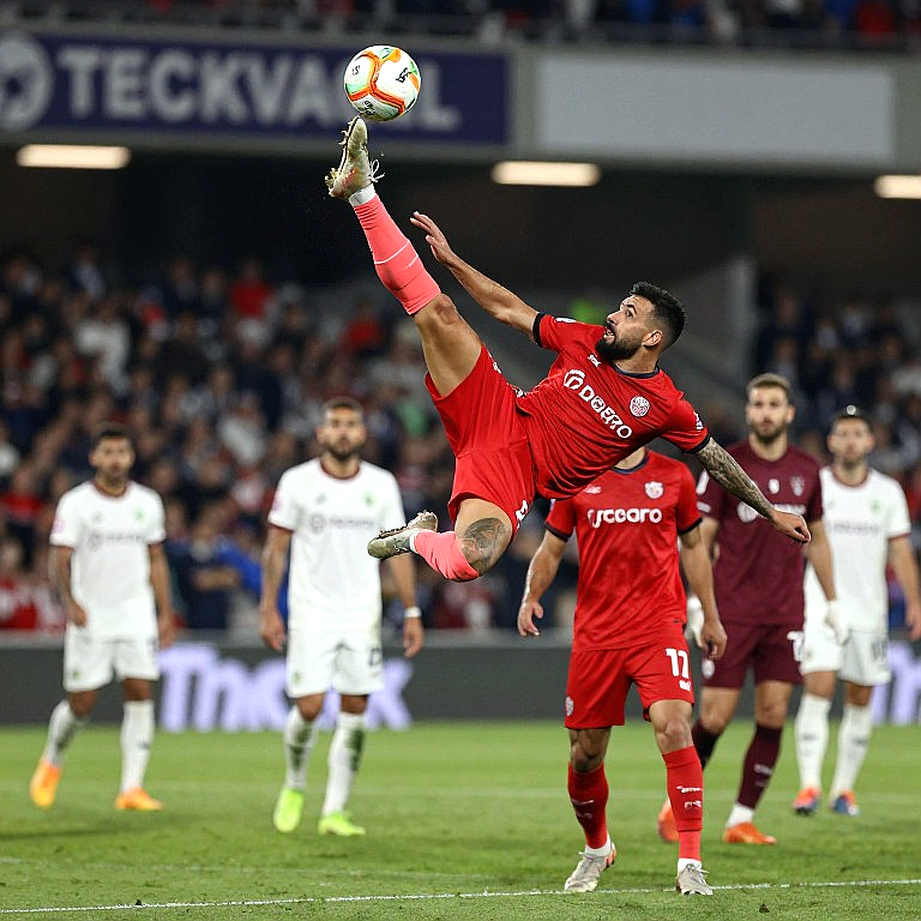
To understand why this event is worth pausing on, look at Olaha's own transfer history. He joined Song Lam Nghe An in 2026 and stayed until 2026, scoring 18 goals in 76 matches. That was the phase of a young, strong striker whose role in the system was not yet defined. In 2026 he moved to Israel to play for Hapoel Tel Aviv, then returned to Song Lam Nghe An from 2026. That second spell was different: 35 goals in 115 matches. Combined, 53 goals in 191 V.League matches, roughly 0.28 goals per game.
For a foreign striker in the V.League, 0.28 goals per game is a level of consistency rather than explosion. But I always read a record a different way: not the total, but the slope between phases. In his first Song Lam Nghe An spell his rate was 0.24 goals per game. After returning, it rose to 0.30. That points to a striker who has matured inside Vietnamese football, choosing positions better and rationing his energy better. A player's body does not lie — it only lowers its voice where nobody bothers to listen.
I must be clear about the limits of this data. There is no expected-goals figure, no per-match minutes distribution, no penalty conversion rate. For a striker, a rise from 0.24 to 0.30 goals per game can come from form, or simply from playing more and playing in a more favourable position. It cannot be determined yet. Someone who decodes data must be willing to say that out loud, rather than assign a performance a meaning it has not yet earned.
More interesting is the physical profile. A 1.86-metre striker in the V.League is usually deployed as a fixed focal point: holding the ball up, contesting aerials, dragging centre-backs out of position. That is the profile a national team needs against opponents who sit in a low block, since Southeast Asian football mostly unfolds in exactly that game state. But this is inference from a profile, not a conclusion from footage. I have no movement data for him this season, and I do not write a player analysis without movement data.
There is one detail I rate above every metric: how he chose his name. "Michael" sits close in sound to "Manh Duc," and the rest is a tribute to two close friends — Pham Xuan Manh and Phan Van Duc — former teammates at Song Lam Nghe An. In naturalization football, failure rarely comes from ability. It comes from isolation: a player with nobody to talk to after a match, nobody to call when substituted on 60 minutes, nobody to trust. A man who takes the names of two friends as his own has told me more than any statistical table. That is data on integration, and it is good data.
At the same time, a second recruitment channel is running in parallel. Williams Minh Hoang, an overseas-Vietnamese striker, has been called up by coach Kim Sang Sik for the ASEAN Cup 2026. Olaha has not. He has said publicly that he believes he still has much to contribute. To me that is not empty confidence but a self-positioning signal aimed at the national-team dressing room. A striker who knows he has not been called up says exactly that.
Placed side by side, the picture sharpens: Vietnamese football is recruiting along two tracks. One is naturalizing foreign players already proven in the V.League. The other is calling home overseas-Vietnamese players born abroad. Olaha belongs to the first. Williams Minh Hoang belongs to the second.
And here I want to go against the story being told. The question almost nobody raises has nothing to do with the name or the age. It has to do with the rulebook. Vietnamese citizenship was granted by a decision at the highest level, and that part is done. But the right to wear the national shirt falls under Article 5 of the FIFA Regulations Governing the Application of the Statutes: a requirement of continuous residence for a set period. Olaha spent two years outside Vietnam, from 2026 to 2026, playing in Israel.
I am not concluding that he is ineligible. Nobody can conclude that without checking the full file. But across every article currently available, I have not seen anyone verify his eligibility status within the FIFA system. In other words, there is an administrative step between the citizenship document and the first cap, and that step has not been publicly checked. It is the least discussed risk in this story, and the heaviest.
Another risk is simpler: age. Twenty-nine is the early part of the slope on the far side. A striker at this age has a window of roughly two to three seasons to produce peak value. If he is not selected in the current cycle, the club's naturalization investment will be hard to recover through the national-team route, and the resale value of a player past his peak will be measured only in V.League goals.
Then comes a systemic risk, and I say this knowing it is unwelcome: a naturalization process that has become routine will gradually take space from domestic strikers. Four cases are not a wave. But four cases are enough to prove this is now a habit rather than an exception. Every striking slot handed to a naturalized player is one fewer slot for a forward raised in a domestic academy. I am not against naturalization. I am against being unwilling to ask questions about it.
Every transfer is a surgery — outsiders see the scar, insiders see the bloodline. Here the scar is a citizenship document and a handsome name. The bloodline is the transfer process, the starting slot of a domestic striker, an unverified eligibility status, and an age window narrowing with every season.
Believe me, physical condition is the only thing in football that cannot be bought through negotiation — the rest is just smoke. Citizenship can be granted with a signature. The right to play must be paid for with something else, and FIFA keeps the books.
So the real question here is not whether Olaha deserves a call-up. It is this: if one morning the name Manh Duc appears on the official Vietnam team sheet, how many people will truly understand why he is standing there — or why he cannot?